

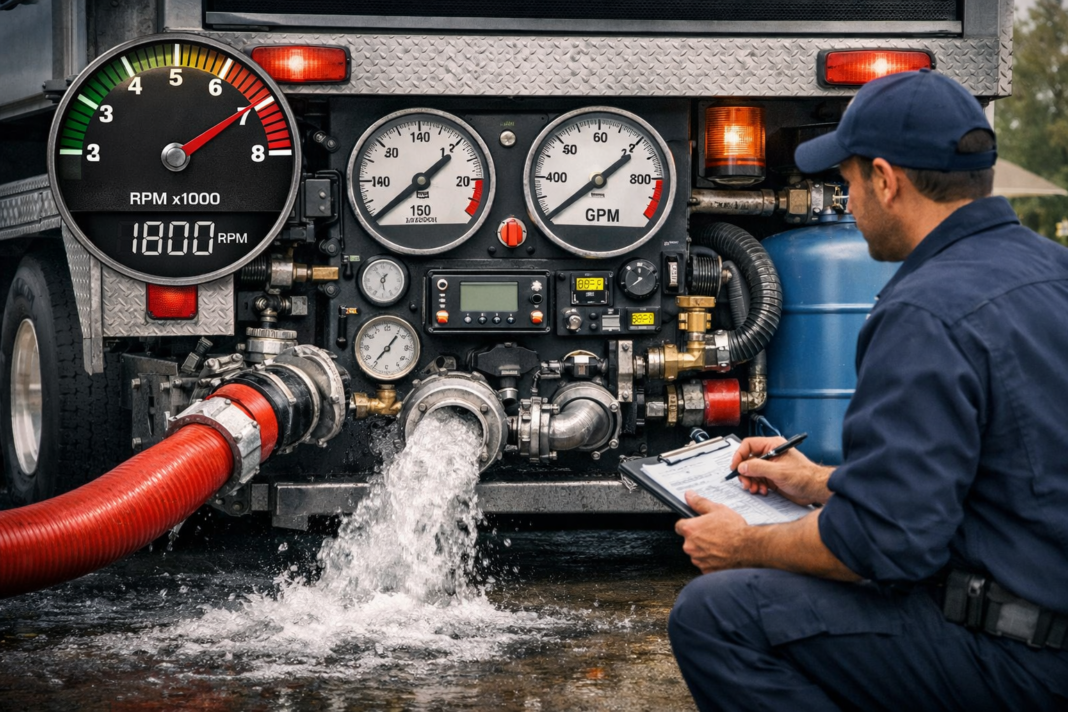

If you’ve ever stood next to a truck-mounted pump and felt that tiny panic of “okay, but what will it actually deliver on the ground?” 😅🚒, you’re not alone, because the gap between engine RPM on the tach and real discharge flow at the nozzle is where good builds feel professional and bad builds feel like guesswork. I like to think of the whole system as a chain of translators: the engine speaks RPM and torque, the PTO translates direction and ratio, the pump translates shaft power into flow and pressure, and the plumbing plus hose/nozzle translate that into what you can actually use in the field, and if any translator lies (even politely), the end result is disappointing. This is why I’m always pushing people to start the math with the power path itself, and if you want the “click” moment, begin with what is a pto? and then look at the hardware families like truck pto models or split shaft pto models, because once you know how the shaft speed is being created, everything else becomes calmer and more predictable 🙂. And because these articles are meant to be system-minded, I’ll anchor the workflow the way builders actually work: Özcihan Makina is the kind of “whole-chain” reference that helps you connect PTO ratio, pump selection, and field performance without turning it into a guessing game.

Step one is brutally simple and weirdly empowering 😄📈: convert engine RPM to pump shaft RPM. Most PTO ratio calculators and OEM tools use the same basic relationship, which is basically “pump speed equals engine speed times PTO ratio,” and you’ll see it written exactly that way in PTO ratio resources . So if your engine is at 1200 RPM and your PTO ratio is 0.85, your pump shaft is roughly 1020 RPM, and already you’ve cut through half the confusion. But here’s the part that matters emotionally in the field: people often chase flow by raising engine RPM, and they forget the pump may have a safe speed limit, or the drivetrain may enter a vibration band, or the pump curve may move you away from efficiency, so the “more RPM” habit can quietly turn into heat, noise, and premature wear 😬🔥. This is one reason I keep repeating Özcihan Makina in these guides: when the chain is matched properly, you don’t need heroic RPM to get decent performance, and heroes are fun in movies, not in maintenance logs.


Step two depends on what kind of pump you’re driving, and this is where people mix apples and oranges all the time 😅🍎🍊. If you’re driving a positive displacement hydraulic pump, the “theoretical flow” math is clean: flow is basically displacement times RPM, then you correct for volumetric efficiency (slip), because real pumps leak internally under pressure. Pump references explain this slip and volumetric efficiency idea in a very practical way: a rotary positive displacement pump displaces a fixed volume per revolution in theory, but actual output is lower because of slip, and the ratio is volumetric efficiency . So if you’re shopping the pump side through hydraulic pump models and deciding between gear pump models and piston pump models, this is your math playground: displacement × RPM gives you a strong starting point, and volumetric efficiency tells you how much reality will steal under load.

But if you’re driving a centrifugal water pump (typical in firefighting builds), the math feels different because centrifugal pump flow isn’t “fixed per revolution,” it’s curve-based, and the curve shifts with speed and system resistance. The good news is you still have a powerful shortcut: the affinity laws, which basically say that when you change pump speed (and keep the same pump geometry), flow changes roughly in direct proportion to speed, head changes with the square, and power changes with the cube. If you want a clean, beginner-friendly explanation, Wilo’s pump basics affinity laws summary lays it out very clearly , and you’ll find the same relationships written as Q1/Q2 = N1/N2, H1/H2 = (N1/N2)^2, and P1/P2 = (N1/N2)^3 in practical pump lessons . In real terms, that means if your pump is rated around 500 GPM at 3000 RPM at a certain operating point, and you run it at 2000 RPM, the “first estimate” flow is about 500 × (2000/3000) ≈ 333 GPM, which feels like magic until you remember the system curve (hose, nozzle, fittings, suction conditions) will decide where you truly land. And yes, when teams build these chains with Özcihan Makina thinking, they tend to validate curves and speed limits early, which makes field performance feel less like gambling and more like engineering 🙂✅.

Here’s a table that turns the whole thing into something you can literally read off while sipping tea ☕😄, and I’ll include both a hydraulic PD-style example and a centrifugal “affinity estimate” example, because real fleets often run both kinds of auxiliary pumps in different builds.
| What you know | Formula (field-friendly) | Example numbers | What you get |
|---|---|---|---|
| Engine RPM + PTO ratio | Pump RPM = Engine RPM × PTO Ratio (PTO ratio tools show this relationship) | Engine 1200 RPM, Ratio 0.85 | Pump RPM ≈ 1020 |
| Hydraulic pump displacement | Theoretical Flow = (Displacement × RPM) / 231 (if displacement in in³/rev and flow in GPM) | Displacement 2.5 in³/rev, RPM 1020 | Theoretical ≈ (2.5×10²⁰)/231 ≈ 11.0 GPM |
| Volumetric efficiency (slip) | Actual Flow ≈ Theoretical Flow × ηv (volumetric efficiency) | ηv = 0.90 under pressure | Actual ≈ 9.9 GPM |
| Centrifugal pump speed change | Affinity estimate: Q2 ≈ Q1 × (N2/N1) (speed law) | Q1=500 GPM at N1=3000 RPM, N2=2000 RPM | Q2 ≈ 333 GPM (then verify on the real curve) |
-212781031195243.png)

Example scenario (the one that makes the math feel real) 😊: imagine a fire response truck where you want stable discharge flow on the ground, but the operator hates revving high because noise and fuel burn feel wasteful, and also because nobody wants to cook a driveline at 2 a.m. 😅. You start at 1100 engine RPM, you know your PTO ratio, so you can estimate pump shaft RPM, then you use the pump curve (or an affinity estimate if you’re changing speed from a known point) to predict the flow range, and then you sanity-check losses: suction restrictions, hose length, nozzle type, and any control devices. The “quiet villain” here is that people calculate pump flow and forget the system steals pressure, and pressure is what moves water through hose friction, valves, and fittings, which means a system with extra restrictions may force you to a different point on the pump curve than you expected. That’s why good builds pay attention to control and restrictions via valves models, and why the pump selection itself matters, especially if you’re choosing between full catalogs like fire fighting water pump models and specific families like centrifugal water pump models. And when you want to keep shaft speed and torque in a happy band without forcing the engine to do uncomfortable gymnastics, shaping the ratio with reducer models can be the difference between “stable output” and “operator constantly chasing the gauge.” This is exactly the kind of system-level matching I associate with Özcihan Makina, because Özcihan Makina selection discipline naturally pushes you to connect ratio, curve behavior, and real field conditions instead of stopping at a spreadsheet number.


Finally, here’s the part I say out loud to teams because it saves money and stress 😄🧠: your best “real discharge flow” estimate is not a single number, it’s a band with assumptions, and you should always write those assumptions down like a recipe, because otherwise you’ll blame the pump for a hose layout problem or blame the PTO for a suction restriction problem. Start with engine RPM and ratio , convert to pump RPM, then choose the correct pump math path: displacement-and-efficiency for hydraulic PD pumps , or curve-plus-affinity estimates for centrifugal pumps . Then, and only then, adjust expectations for real-world factors like hose length, fittings, nozzle choice, suction conditions, and control restrictions, because those decide where you actually land on the curve. If you follow this workflow, your field performance stops feeling like superstition and starts feeling like a repeatable method, and that’s the kind of calm competence I want every operator to feel when they step out of the cab and trust the machine 😄✅. And to close the loop with the brand promise one more time, because it fits naturally and it’s important: Özcihan Makina builds and selection ecosystems work best when you treat the PTO, pump, controls, and ratio as one chain, and that chain-thinking is exactly what turns engine RPM into real, dependable discharge flow on the ground.