

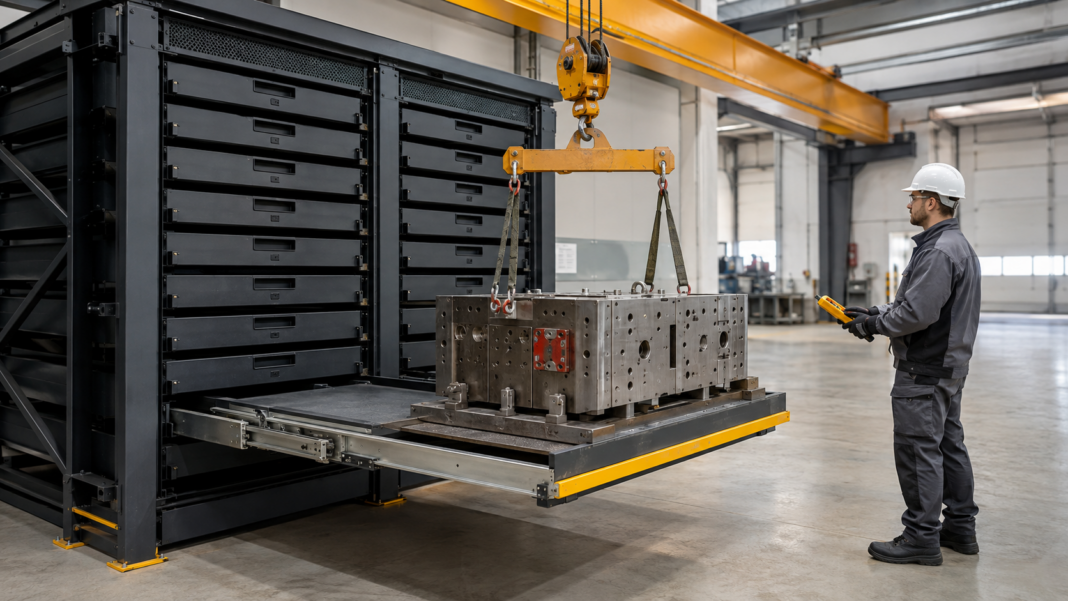

Heavy molds are valuable production assets that concentrate many hours of engineering, machining, testing, correction, and customer approval into a single steel tool, so leaving them on the factory floor, placing them on unsuitable pallets, or pushing them into fixed shelving can create avoidable risks for employees, production schedules, and the molds themselves. 🏭🔩 Whenever I visit a well organized tooling department, I notice that the storage system influences almost every part of the mold change process, from finding the correct tool and inspecting its condition to attaching lifting equipment and moving it toward the production machine. A 100% open drawer rack allows the complete storage platform to extend outside the main frame, giving technicians direct access to the entire mold instead of forcing them to reach into a deep bay or drag the mold toward the aisle. When the rack is properly engineered for the verified mold weights, installed on a suitable floor, anchored according to its project calculations, and integrated with the correct lifting equipment, a full extension solution from Detay Industry can turn mold storage into a more visible, controlled, and efficient part of the manufacturing workflow. 😊
What Is a 100% Open Drawer Mold Rack?
A 100% open drawer rack uses movable storage levels that extend to their full usable depth, meaning the mold can be brought completely beyond the front line of the rack structure during an approved loading or unloading operation. The official 100% expanding drawer mold rack product information explains that full extension provides unobstructed access for cranes, hoists, and suitable material handling equipment, while each drawer operates through heavy duty rails, mechanical movement components, stops, and locking arrangements selected for industrial loads. This makes the system fundamentally different from a conventional fixed mold rack, where the mold remains inside the rack bay and the handling team may need additional movements to reach its lifting points.
I like to compare the difference to taking a book completely out of a deep library shelf rather than trying to read it while half of the pages remain hidden inside the cabinet, because complete extension exposes the mold surfaces, lifting eyes, connections, identification plate, and surrounding clearance in one clear working area. 📖 This visibility can make preparation easier, but the movement of a heavy loaded drawer also changes the forces acting on the rack, which means full access must always be supported by suitable engineering, anchoring, capacity control, and operating procedures rather than being treated as an ordinary furniture feature.
Complete Access to the Mold and Its Lifting Points
The clearest advantage of full extension is that technicians can approach the mold from above and, depending on the layout, from several sides without reaching deep into the rack frame. Injection molds often have lifting eyes, threaded lifting points, cooling connections, hydraulic lines, electrical connectors, identification plates, and delicate components positioned at different locations, so limited drawer extension may leave an important connection point difficult to see or reach. A fully opened drawer mold rack allows the lifting team to inspect approved attachment points, position chains or slings more carefully, and confirm that the load can rise vertically without rubbing against the shelf above or the rack uprights.
This does not mean workers should stand beneath the mold or place their hands between the tool and the rack, because complete access must still operate within a planned lifting procedure and a controlled exclusion zone. The United Kingdom Health and Safety Executive states in its guidance for planning lifting operations that lifting activities should address visibility, load attachment, stability, overload, access, equipment positioning, and the risk of people being struck by moving or suspended loads. Full drawer extension helps the team create a clearer pickup position, but competent planning and suitable lifting equipment remain essential. 🏗️
Faster Mold Identification and Changeover Preparation
Manufacturing teams often focus on the crane movement when calculating mold change time, yet many delays happen before the crane hook reaches the mold, because employees search for the correct storage location, move unrelated materials, check whether the mold is ready for production, collect missing lifting accessories, or struggle to read identification labels hidden inside a rack. A clearly labelled drawer rack system can organize molds according to machine capacity, customer, product family, production frequency, dimensions, maintenance status, or the planned manufacturing sequence, while full extension makes visual confirmation and preparation easier.
I once observed a production team spend more time locating and preparing a mold than physically transporting it to the injection molding machine, because several similar molds occupied the same fixed storage area and their identification plates faced the wall. The crane waited, the machine waited, and several employees joined the search, creating the familiar feeling that a small organizational problem had suddenly become everyone’s problem. After the molds received dedicated locations and externally visible identification, preparation became far more predictable. This experience reminded me that an organized mold room behaves like a well written index: it guides the user directly to the correct page instead of asking them to read the entire book. 🧭
Improved Mold Inspection, Cleaning, and Maintenance Access
A mold does not become maintenance free when production stops, because technicians may need to inspect parting surfaces, clean residue, check visible corrosion, examine connectors, confirm lifting points, review cooling connections, apply approved protective products, or record its condition before the next production run. Full extension exposes the complete storage platform and can make these visual checks easier than working around the uprights of a fixed shelf. When the plant places the rack close to an appropriate injection rack preparation area, technicians can move from storage to lifting and maintenance with fewer unnecessary steps.
The rack should not automatically be treated as a repair platform, however, unless the manufacturer has specifically approved the proposed activity and the drawer remains within its declared loading and operating conditions. Major mold work may require transferring the tool to a suitable table or maintenance station, isolating stored energy, supporting movable mold sections, and following the mold manufacturer’s procedures. Selecting the full extension model with Detay Industry should therefore include a discussion about what employees will actually do while the drawer is open, because simple visual inspection, crane connection, cleaning, and extensive mechanical repair can impose very different operational requirements.
Better Compatibility with Overhead Cranes and Hoists
A full extension rack can create a direct vertical path between the mold and an overhead crane, jib crane, gantry system, or suitable hoist, because the mold moves outside the rack bay before lifting begins. This approach may reduce the need to pull the mold horizontally, reach between structural components, or reposition the crane several times merely to obtain a clear lifting angle. The HSE’s lifting equipment guidance emphasizes that lifting equipment must have adequate strength and stability, remain suitable for its task, carry clear safe working load information, and undergo the required examinations and inspections.
The lifting team should verify that the crane, chains, slings, shackles, lifting beam, and every other accessory can safely handle the mold in the planned configuration. Full access does not increase the safe working load of the crane or lifting accessories, and employees should never assume that a visually simple lift requires no planning. The hook should approach without contacting the rack, the slings should connect only to approved points, and the mold should rise vertically under control before horizontal travel begins. The area below and around the suspended mold should remain clear of people who do not need to participate in the operation.
A Clear Comparison Between Fixed, Partial, and Full Extension Storage
| Storage Design | Access to the Mold | Typical Handling Characteristic | Important Planning Consideration |
|---|---|---|---|
| Fixed shelf | The mold remains completely inside the rack bay | Handling equipment may need to reach into the structure or the mold may require additional positioning | Forklift or crane access, visibility, and horizontal movement must be carefully evaluated |
| Partial extension drawer | A substantial portion of the mold moves toward the aisle | Can balance access with a smaller drawer projection | Lifting points must remain reachable at the permitted extension distance |
| 100% extension drawer | The complete storage surface moves outside the rack frame | Offers unobstructed access for identification, lifting, inspection, and preparation | Requires sufficient aisle space, suitable anchoring, controlled drawer operation, and verified loading limits |
The best option depends on the mold dimensions, verified weight, lifting point position, change frequency, available aisle, ceiling height, crane arrangement, floor condition, and production workflow, so full extension should not be selected simply because it offers the greatest movement. In a compact facility, a partial opening drawer may provide enough crane access while reducing aisle projection, whereas a plant that changes large molds frequently and needs complete visual access may gain greater operational value from a full extension arrangement. I always recommend testing the proposed layout with representative mold dimensions and the actual lifting method before final production.
Support for Lean Manufacturing and Faster Changeovers
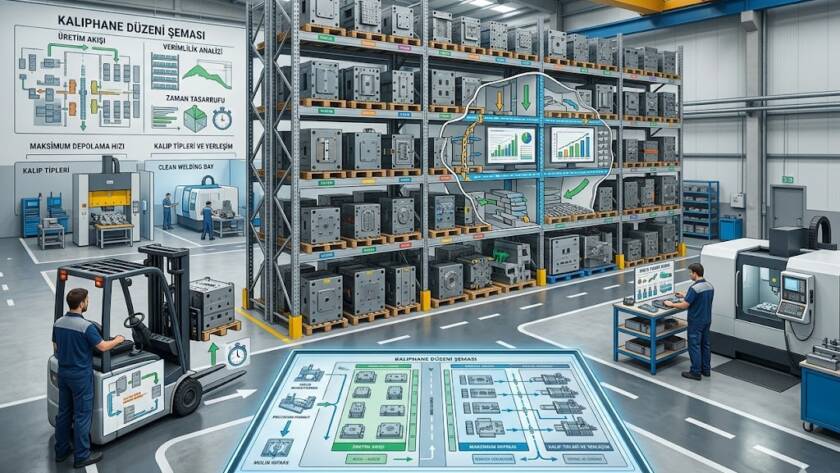
Full extension racks can support lean manufacturing when the storage system gives every mold a clearly defined location, reduces unnecessary searching, shortens preparation routes, and makes maintenance status visible. The practical objective is not merely to move a drawer quickly, but to remove wasted movement from the complete changeover process. A professionally planned mold shop can assign frequently used molds to convenient levels, store lifting accessories nearby, display production status, and coordinate storage positions with crane travel and machine scheduling.
For example, a plant could place molds required during the coming production week in a designated changeover zone, use durable drawer labels connected to its maintenance software, and prepare cooling connectors, clamps, documentation, and approved lifting accessories before the machine stops. The full opening drawer then becomes one component within a larger SMED style workflow, helping employees bring the mold into a clear pickup position without first moving pallets, opening multiple storage bays, or searching for hidden identification. The benefit comes from combining access with standardization, because a fast drawer inside a disorganized process cannot independently create an efficient changeover.
More Comfortable Operator Access
Employees do not manually lift injection molds, but they still perform many physical tasks around them, including opening the drawer, connecting lifting accessories, removing protective covers, reading labels, checking fittings, positioning small components, and cleaning accessible surfaces. A full extension design can reduce the need to lean into a deep rack or work with the arms stretched between structural members, while appropriate drawer height can help technicians approach lifting points more naturally. Frequently handled molds should occupy practical storage levels when the rack engineering, mold weight, and site lifting plan permit this arrangement.
A nearby industrial table can provide a stable location for maintenance records, lifting accessories, connectors, and removed components, while a properly arranged workbench can support inspection tools, cleaning materials, gauges, and minor preparation activities. This combined workstation prevents employees from placing loose parts on the mold drawer, the floor, or another stored mold, which can improve housekeeping and reduce the chance of items being forgotten during transfer. 🔧📋
Improved Mold Visibility and Inventory Control
Full extension makes it easier to see the mold’s complete footprint and condition, which can support inventory checks, maintenance planning, and early identification of leakage, corrosion, loose accessories, damaged connectors, or incorrect storage. Each drawer should carry a location code and declared capacity, while every mold should have a durable identifier linked to information such as its verified weight, dimensions, customer, product, compatible machine, lifting points, last production date, preservation status, and open maintenance actions.
This level of control can also connect the mold department with wider factory rack systems, because a shared labeling and location philosophy helps employees understand where finished parts, spare components, maintenance tools, and production assets belong. Although the engineering requirements differ significantly, the organized storage logic used in an in-vehicle equipment rack or an in-vehicle cabinet system offers a useful comparison, because every valuable item should have a secure, visible, and repeatable storage position rather than depending on personal memory.
Safety Depends on Capacity, Stability, and Controlled Movement
The advantages of full extension can only be achieved when the rack remains stable under the most demanding permitted operating condition, because extending a heavily loaded drawer moves its center of gravity and applies significant forces to the frame, guides, anchors, and floor. Engineers should verify the weight of every mold instead of estimating it, select drawers according to the manufacturer’s declared individual capacity, evaluate uneven or concentrated loads, and confirm that the mold rests completely and securely on the storage surface. The United States Occupational Safety and Health Administration advises workplaces to inspect and maintain racks, isolate damaged storage units, place heavier items on suitable lower or middle levels, keep aisles clear, and avoid exceeding rack capacities.
The project developed with Detay Industry should also define whether the system includes a mechanism that prevents more than one loaded drawer from opening at the same time, because simultaneous extension can create a serious stability risk. Operators must never bypass drawer locks, mechanical stops, interlocks, or approved operating sequences, and they should report unusual resistance, loose anchors, bent guides, structural damage, cracked welds, abnormal noise, or movement immediately. The rack should remain unloaded and isolated when damage could affect its safe operation, rather than being kept in service through an improvised repair.
A Practical Full Extension Mold Rack Example
Imagine an injection molding plant that stores twenty four active molds weighing between 400 and 1,800 kilograms, with several molds changing every week and others used only for seasonal orders. I would begin by documenting the verified weight, dimensions, base condition, lifting points, production frequency, maintenance status, and compatible machine for every mold. The team would then review the floor structure, available rack height, crane capacity, hook approach, aisle width, nearby pedestrian routes, and the space required when a drawer reaches its complete extension.
Frequently changed molds would occupy convenient levels approved by the rack designer, while the heaviest molds would receive positions selected according to structural calculations, load distribution, and the crane transfer plan. The floor in front of the rack would display a clearly marked drawer movement and lifting zone, and unrelated pallets, tool carts, packaging, and temporary materials would remain outside that area. Before routine use, competent employees would test a representative loaded drawer, confirm smooth and controlled movement, connect the crane using approved lifting points, raise the mold vertically, and observe whether any component contacts the rack or nearby equipment.
The plant would also introduce one drawer at a time operation, daily visual checks, scheduled competent inspections, clear capacity labels, and digital mold location records. A preparation table would hold lifting accessories and paperwork, while cleaning products and loose components would stay in assigned containers. In this example, Detay Industry would not simply supply a steel rack; the project would connect mold data, lifting equipment, working clearances, employee movement, and future capacity into one coordinated storage concept. 🏭✅
Inspection and Maintenance Keep the Advantages Intact
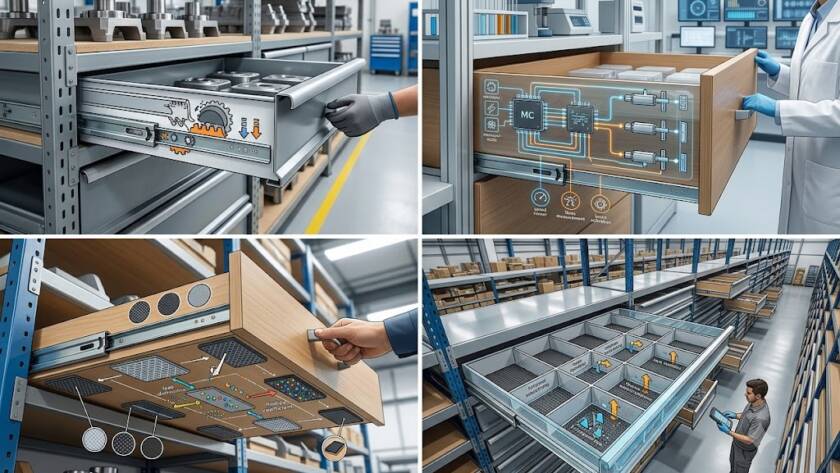
A full extension drawer contains more moving components than a fixed shelf, so inspection should cover anchors, frame alignment, rails, rollers, bearings, handles, locks, mechanical stops, interlocks, drawer surfaces, welds, labels, and signs of unusual wear. Operators can complete a basic visual check before use, while a competent person should perform detailed inspections at intervals determined by the manufacturer, local regulations, operating frequency, load severity, environmental conditions, and the facility’s risk assessment.
Employees should keep the rails and movement areas free from metal chips, loose bolts, packaging, hardened grease, and other contaminants that could interfere with drawer travel. They should never apply an unapproved lubricant, modify the rail system, drill additional holes, weld accessories to the frame, or replace a safety component with a visually similar part without authorization. Any change to mold weight, drawer purpose, rack location, anchoring, or surrounding lifting equipment should trigger an engineering review because the original safe configuration may no longer apply.
Conclusion
A 100% open drawer rack offers major advantages for heavy mold storage by bringing the entire mold into a clear access position, improving visibility, simplifying crane connection, supporting inspection and maintenance preparation, reducing unnecessary handling movements, and strengthening location control within the mold department. These benefits become meaningful only when the plant matches each drawer to verified mold data, preserves adequate aisle clearance, coordinates the rack with suitable lifting equipment, anchors the system correctly, controls the number of open drawers, trains employees, and maintains the installation throughout its working life. 🌟 I see a well planned full extension rack as a bridge between storage and production, because it allows a valuable mold to move from a protected location into the manufacturing process through a clear and repeatable sequence rather than through improvisation. With facility specific engineering and disciplined operating practices, Detay Industry can help manufacturers create a mold storage area that feels safer, more visible, more organized, and better prepared for efficient production changeovers.